
Plasterboard is one of the heaviest and least forgiving things a merchant stores.
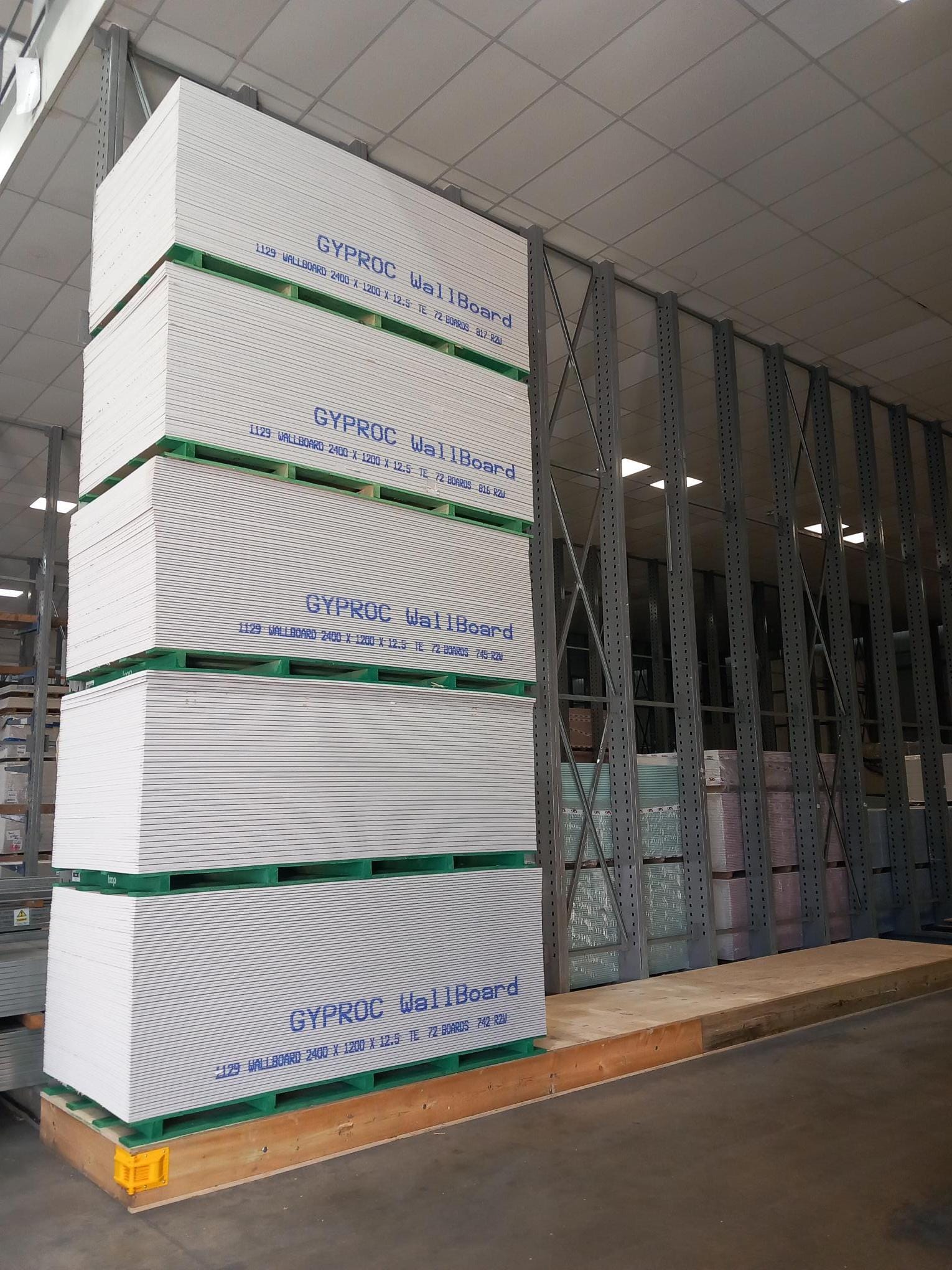
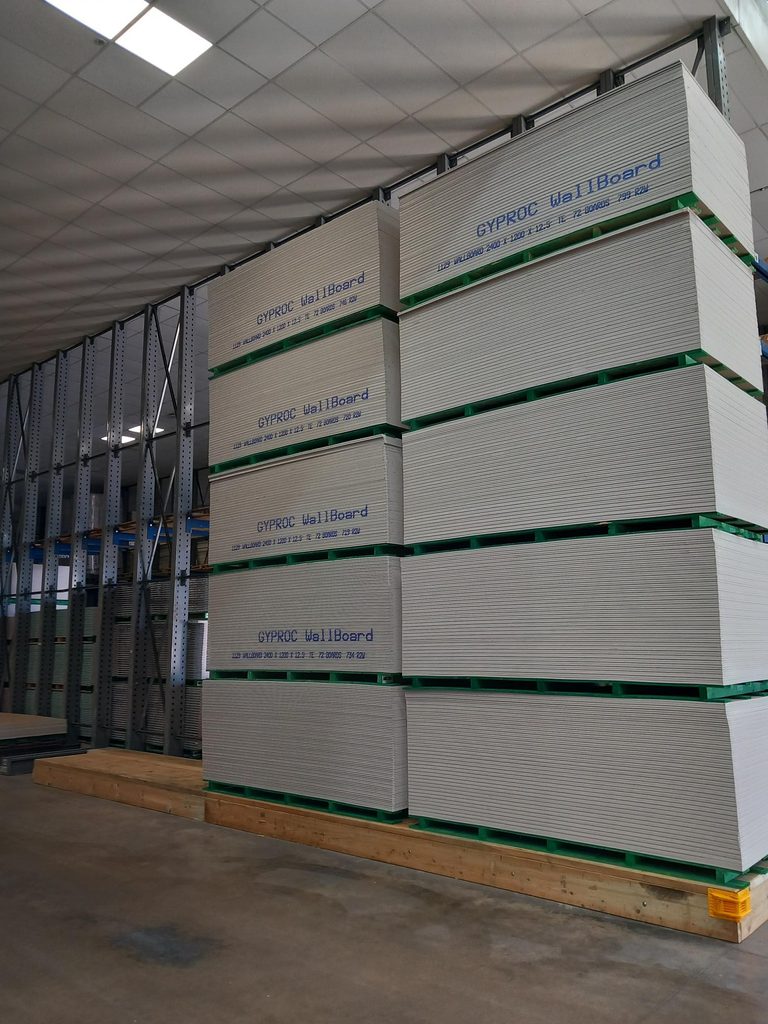
Every pack of Gyproc WallBoard in these photos holds 72 boards. At 24.9kg a board, that’s close to 1.8 tonnes a pack. Stack five high and you’ve got roughly nine tonnes sitting on a 2.4m x 1.2m footprint.
For SIG, we built what that weight sits on: a heavy-duty timber deck along the base of the racking, so packs go in flat, level and straight, five high.
So when does timber decking make sense for racking? We’ll give you the short answer first, then show how we used it at SIG.
When does timber decking make sense for racking?
Timber decking makes sense when the load needs a continuous, flat surface that bare beams or an uneven floor can’t give it. It also needs someone to tell you, in writing, what the deck is rated to carry.
It’s a good fit when:
- The stock is long, flat and heavy. Plasterboard, sheet materials and board need support along their full length, not just at two points.
- The floor isn’t playing ball. Cracks, dips and base plates at the foot of the racking all stop a pallet sitting flat. A deck gives it one level surface instead.
- Pallets are poor or mixed. Undersized or tired pallets that won’t sit safely across two beams are better on a solid surface.
- You want repairs to stay cheap. A damaged board can be cut out and replaced on site.
It’s the wrong call when:
- Things get wet. Timber soaks up spills and damp. Mesh or steel copes better.
- Sprinkler water needs to get through. Solid decking can block it, so it needs signing off by your fire engineer or insurer first.
- Hygiene matters. For food or pharmaceutical stock, mesh is far easier to keep clean.
- Nobody can give you a load rating. If the person fitting it can’t tell you what it holds, don’t put a nine-tonne stack on it.
SIG’s plasterboard store ticks the first two boxes: 1.8-tonne packs of board that need full, flat support, stacked five high at the foot of the racking.
Why plasterboard is so hard to store well
Board doesn’t like being half supported. A 2.4m pack that sits over a base plate, a crack in the slab or a dip in the floor won’t sit flat. The bottom boards bow, the edges crush and the stack starts to lean, a little more with every pack you add on top.
British Gypsum’s guidance puts the maximum at six packs high for 2400 x 1200 board. That’s on level concrete, with stacks that are level and vertical. That last condition is the bit people skip.
Then there’s damp. Plasterboard is gypsum between paper liners, and the paper wicks up whatever is on the floor. Spilt water, a wet forklift tyre, rain blown in through the doors. Lose the bottom few boards of a pack and you’ve lost money before it’s left the building.
What we built for SIG
A timber deck along the base of the racking
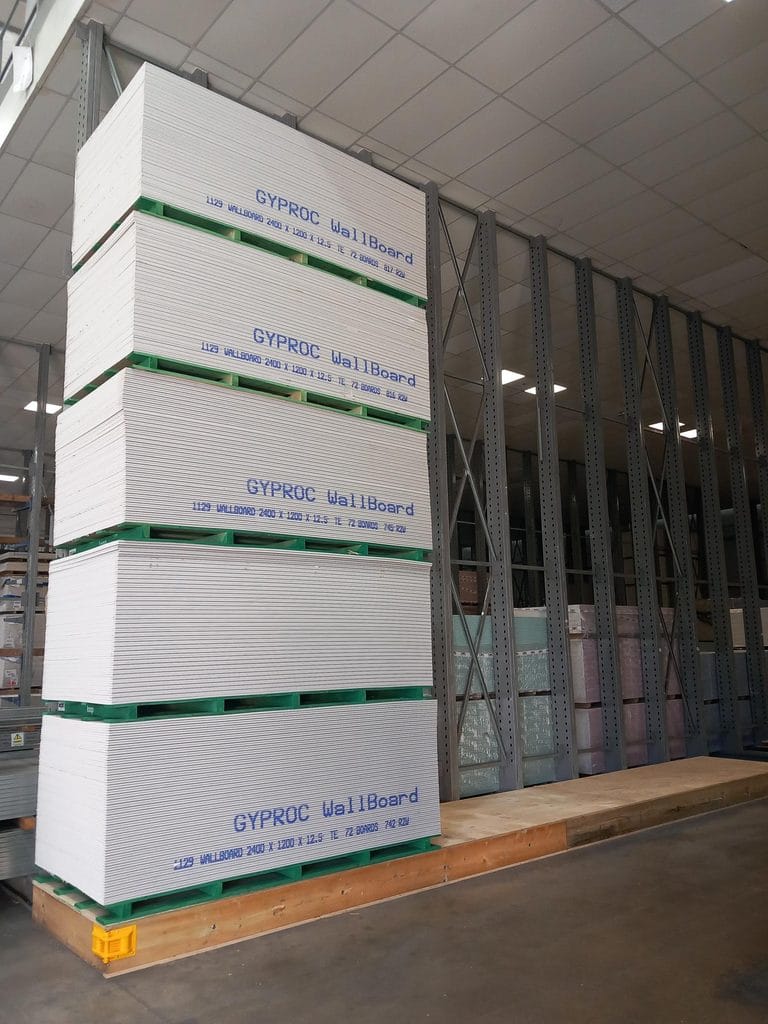
We built a solid timber deck along the racking run. It has a boarded top and a solid timber face along the front edge. Bright yellow guards cover the exposed corners at the ends.
The point is simple. Every pack gets the same flat, continuous surface to sit on, whatever the floor underneath is doing. Timber is our trade as much as racking is (it’s why we build timber buildings too), so we could cut and fit the deck around the uprights on site rather than forcing a standard product to fit.
Packs that go in flat and straight
British Gypsum now ships much of its board on The Pallet LOOP’s green reusable pallets, a 2400 x 1200mm two-way entry design. That’s what you can see in the photos. With the deck under them, each pallet is supported along its full length, and the racking uprights either side frame each column so it goes up straight.
Five high keeps SIG one pack under British Gypsum’s six-pack limit. We think that margin is worth keeping.
Protection where the forklifts work
The yellow end guards do two jobs. They take the knocks that would otherwise split the timber, and they show drivers exactly where the deck ends. The front face gives them a clean line to set packs down against.
Why timber and not mesh or steel?
We’re big fans of mesh decks. We’ve fitted plenty, including across Selco stores. But mesh is built for beam levels, where it stops pallets and stock dropping through the rack.
Down at the base, under stacked packs of board, the job is different. You want a continuous flat surface that spreads the load. Timber does that well, it can be cut to suit the bay on site, and one damaged board can be swapped out without ripping up the lot.
It has its trade-offs. Timber soaks up spills, it can block sprinklers and it wears under forklift traffic. None of that rules it out. It just means timber decking needs inspecting like any other part of the racking.
Timber decking for racking: what a racking inspector looks for
Ross is a racking inspector, so he looks at decking the way he looks at the rest of the racking. The question isn’t whether it looks solid. It’s whether anyone knows what it’s rated to carry.
This is what we’d check on any timber deck, ours or anyone else’s:
- A stated load rating. The safe working load of timber decking varies widely, so there’s no average figure to fall back on. Get it in writing from whoever builds it. At SIG, the deck is carrying around nine tonnes per stack.
- Level and flat. The deck has to give the pallet the level base the manufacturer’s guidance assumes.
- Fixings and edges. Loose boards, lifting edges and split ends are where damage starts.
- Damp and rot. Soft or blackened timber gets replaced, not painted over.
- Stacks standing on their own. Racking frames aren’t retaining walls. If a stack is leaning on an upright, the frame is carrying a load it may not have been designed for.
- Damage logged and acted on. Decking belongs in your racking inspection like everything else.
The result for SIG
SIG now has a flat, level base along the racking run, where plasterboard goes in five high and straight. The corners are protected and the bottom pack is off the floor.
It’s a small job next to a full racking install. But it does what a lot of yards get wrong: it gives the heaviest stock in the building something proper to stand on.
Frequently asked questions
Is timber decking strong enough for racking?
It can be, as long as it’s specified for the load it will carry. Timber decking has no standard rating, so ask your supplier for a safe working load. Don’t fit it until you have one.
How high can you stack plasterboard pallets?
British Gypsum’s guidance allows six packs high for 2400 x 1200 board, on level concrete, with stacks that are level and vertical. If the packs sit on a deck, the deck has to be rated for the full weight of the stack.
Does timber decking affect sprinklers?
Solid decking can stop sprinkler water reaching stock below or behind it. If your building is sprinklered, check with your fire engineer or insurer first.
How often should timber decking be inspected?
The same as the rest of your racking: regular in-house checks, plus an expert inspection at least once a year. Our guide on how often to inspect racking covers it in more detail.
Thinking about timber decking for your racking?
If you’re storing board, sheet materials or anything heavy and flat, and the base it sits on has never been looked at properly, it’s worth a conversation. We’ll tell you whether timber is the right call, what it needs to carry, and whether anything else in the racking needs attention while we’re there.