
If you run a builders merchant, your racking is doing one of the hardest jobs on site. It’s holding tonnes of timber, blocks, bagged aggregate and heavy stock, often in a busy yard where forklifts are working in tight spaces all day. It’s easy to walk past it every morning and never really look at it. But racking is a safety-critical system, and how often you inspect it can be the difference between spotting a problem early and dealing with a collapse.
So how often should you inspect racking? Here’s how we answer that for the merchants we work with.

Table of Contents
Racking Inspection Frequency
There are two layers you need running at the same time.
Someone in-house should be doing a visual check every week. This is a trained member of your own team walking the racking, looking for damage, and knowing when to stop and call for advice.
On top of that, an approved racking inspector should carry out a formal inspection at least once a year. For busier or higher-risk sites, that annual visit may need to become every six months.
Neither one replaces the other. The weekly check catches new damage quickly. The annual inspection is the expert eye that picks up the things a general visual check will miss. A lot of the businesses we speak to think one inspection a year covers them. It doesn’t, and that gap is where accidents happen.
What Pushes You From Twelve Months To Six
Twelve months is the ceiling for inspections. And the useful question isn’t “what does the guidance say”, it’s “what is my site actually doing to this racking?”
Move to six-monthly, or more often, if any of these apply to you:
- Heavy forklift traffic. Several trucks, long shifts, or a yard where the machines barely stop moving.
- Tight aisles and awkward turns. The less room a driver has, the more the frames get clipped.
- Agency, seasonal or newly trained drivers. Skill and care vary, and racking keeps a record of the difference.
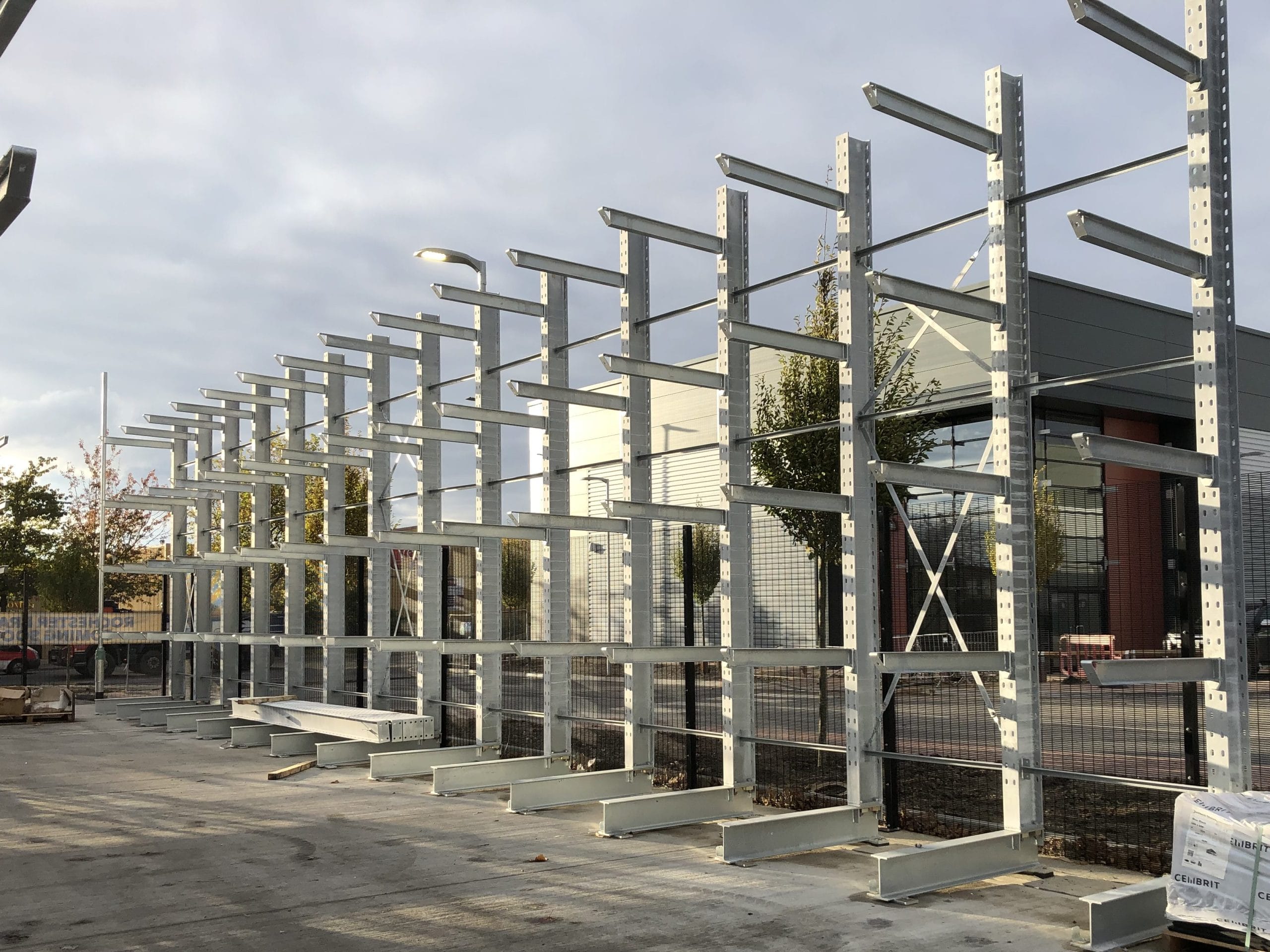
- Racking outside or part-covered. Weather, corrosion, and none of the forgiveness you get from a dry indoor warehouse.
- Heavy or awkward loads. Blocks, bagged aggregate, timber lengths, sheet materials — anything running near the top of the rated capacity.
- A history of damage. If you’ve had amber or red findings before, you will have them again.
- Recent repairs or modifications, especially anything done in-house.
- Poor floor or yard surface. Cracked slab, potholes, or racking standing on ground that’s moved.
- No weekly check actually happening. If nobody walks the racking between annual visits, the annual visit is doing all of the work on its own.
- Customer or public access. Trade counter areas and self-select yards, where people who don’t work for you are walking underneath loaded racking.
Two or more of those and twelve months is too long a gap. Most builders merchants we work with have at least four.
Where The Rules Actually Come From
One thing that causes confusion is that there isn’t a single law that says “inspect your racking every 12 months.” The duty is built from a few pieces sitting on top of each other.
The Health and Safety at Work Act 1974 requires you to provide a safe workplace. The Provision and Use of Work Equipment Regulations 1998 (PUWER) treat your racking as work equipment that must be kept in a safe condition and inspected. The Management of Health and Safety at Work Regulations 1999 require you to assess and control risk.
The practical “how often” then comes from HSE guidance, specifically HSG76 (Warehousing and storage: A guide to health and safety), and from the SEMA code of practice. Between them they set out the layered system of everyday reporting, regular in-house visual checks, and an annual expert inspection.
The key point to understand is that twelve months is a maximum, not a target. If your site is busy, your loads are heavy, or you’ve had knocks and impacts before, more frequent expert inspections are the sensible and often necessary answer.
The Three Levels Of Checking
Good racking safety works on three levels, and each one matters.
The first is everyday awareness. Anyone working near the racking should be trained to recognise damage and report it straight away. This is your early warning system and it costs nothing to put in place.
The second is the weekly visual check. HSE guidance calls for a named individual to own this, the Person Responsible for Racking Safety, or PRRS. It’s a role rather than a job title, and on most merchant sites it lands with a yard manager or a supervisor who’s out there every day anyway.
Your PRRS walks the racking, looks for damage, checks that loads are inside the rated limits, and keeps a written record of every walk. Including the ones where nothing was found, those clean records count just as much as the ones with findings on them. The one thing a PRRS has to understand is where their competence stops. If they see something and they’re not sure about it, the answer is to call a qualified racking inspector, not to make a judgement call and hope. Nobody has ever been criticised for asking.
The third is the annual expert inspection carried out by an approved racking inspector. This is the thorough, technical assessment that grades damage properly and tells you what needs to happen and how quickly. This is the level of inspection we cover.
What A Racking Inspection Checks
“Racking inspection” stays a vague phrase until you’ve watched one done properly. It isn’t someone walking the aisles with a clipboard having a general look at things. It’s a structural assessment, worked through component by component.
The core of it is the same on every site.
Uprights and frames. Bends, dents, twists and splits in the columns, and whether any distortion sits inside the allowable tolerance or outside it.
Beams. Deflection under load, damage at the ends where forks catch them, and whether the beam is still doing the job it was rated for.
Frame bracing. The horizontal and diagonal members that stop a frame moving sideways. These get clipped constantly, and it’s often the damage a site misses first.
Floor fixings. Anchor bolts loose, missing, or pulled out of the slab. A frame that isn’t properly fixed to the floor isn’t really a frame. It’s a wall of steel waiting for a knock.
Beam connectors and lock-in clips. The safety clips that stop a beam being lifted out of its slot by a fork. We find these missing on a lot of sites. It’s also one of the cheapest and fastest things to put right.
Load notices. Whether the signage is there at all, whether it’s still readable, and whether it matches what’s actually being stored on that run. A load notice that’s three stock changes out of date is worse than none, because people trust it.
On a merchant site there’s a second list, the one a standard warehouse inspection tends to skip.
Corrosion. Anything in the yard, under a canopy, or sat near an open door. Rust doesn’t announce itself. By the time it’s obvious on the outside of a column, it’s usually been eating into the section thickness for a while.
Base plates. Where water sits, where salt gets dragged in on forklift tyres, and where corrosion on outdoor racking almost always starts. We get down and look at the bottom 300mm of every frame, because that’s where it hides.
Ground and floor condition. Cracked or sinking slab, potholes, uneven yard surface. Racking is only as level as the thing it’s standing on, and a frame that’s out of plumb is carrying its load at an angle it was never designed for.
Cantilever arms and columns. The racking most merchants depend on for timber, sheet materials and lengths. Different failure points from pallet racking, and it has to be checked differently.
We inspect pallet racking, cantilever racking, outdoor and yard racking, and small parts shelving and mezzanine areas. If it’s holding stock on your site, it should be on the list.
What Damages Racking
When we inspect racking for builders merchants, the same problems come up again and again. These are the things that decide whether a site needs checking more often than the annual minimum.
The most common by far is forklift damage. Trucks working in tight spaces with heavy loads clip frames and beams, and over time that damage adds up. The busier the yard and the tighter the aisles, the more often you need eyes on the racking.

Weather is the next one. A lot of merchant racking lives outside or part-covered in the yard, and we regularly find frames that are corroding. Corrosion weakens racking quietly, so exposed outdoor racking should be watched more closely than anything sitting in a dry, indoor warehouse.
Overloading is another recurring problem. Stores put more weight on a beam or a bay than it was ever designed to carry, often without realising. If your team doesn’t know the rated capacity of the racking, they can’t tell when they’ve exceeded it.
And then there’s the one that worries us most: damage that’s been repaired badly in-house. We often find racking that’s been patched up by someone on site with a repair that doesn’t meet the required safety standard. It looks fixed, so everyone assumes it’s safe, but it isn’t. Racking repairs need to be done to the correct standard with the right components, not improvised.
When To Stop Waiting And Get It Checked Now
Some things don’t wait for the next scheduled inspection. Get the racking looked at straight away if:
- A forklift has hit it. Any impact, however minor it looked at the time.
- It’s been moved, taken down and reset, or extended.
- Beam levels have been changed. Adjusting beam heights alters the capacity of the whole frame, and your load notice is now wrong.
- You’ve changed what you store on it. Heavier stock, a different pallet type, longer lengths, or bulk bags where boxed goods used to sit.
- A load has fallen, shifted, or come off a beam.
- Someone has carried out a repair in-house.
- There’s been a flood, a fire, or vehicle damage anywhere near the run.
- A member of staff reported something and nobody went back to look at it.
If you’ve just read that list and one of them happened three months ago and nothing was done about it, that’s your answer. Book it.
How Damage Should Be Graded
When an approved racking inspector assesses your racking, damage is graded using a simple traffic-light system, and it’s worth your in-house team understanding it too.
Green means the damage is within the allowable tolerance. It’s recorded and monitored at future inspections, but no immediate action is needed.
Amber means there’s damage serious enough to need repair. The affected racking should be offloaded as soon as practically possible and not reloaded until it’s fixed. Important detail here: if amber damage isn’t dealt with within four weeks, it automatically becomes red.
Red means serious damage. The racking must be offloaded and isolated immediately until it’s put right. This is the point where a rack is at real risk of failure.
Understanding these grades helps your weekly checker know the difference between “keep an eye on it” and “stop, offload this now.”

What You Get Afterwards
An inspection is only worth something if it leaves you holding a document you can act on and, if it ever comes to it, produce.
Here’s what we hand over.
- A written report covering every run of racking on site.
- Photographs of the damage we find, so you can see exactly what we saw and where it is.
- Every item graded green, amber or red, using the traffic-light system above.
- A prioritised action list with timescales. What has to be dealt with today, what’s on the four-week clock, and what’s simply being monitored.
- A quote for the repair work, so you’re not left with a list of problems and no way to fix them.
That last one matters more than it sounds. Plenty of inspections finish with a report and a shrug. Ours finishes with a price and a plan.
Then keep the reports. All of them.
If there’s ever an incident on your site, the first question asked will be what you knew and when you knew it. A file of dated inspection reports, with the actions you took recorded against each one, is the difference between a business that took its duties seriously and a business that can’t prove it did. Your insurer will want to see the same file. So will HSE.
That file is your evidence. Build it from the first inspection onwards.
Why This Matters More Than It Might Seem
It’s tempting to see inspections as an unnecessary cost, especially when the racking looks fine. But your racking is a critical safety system holding heavy loads above people working underneath it. When racking fails, it tends to fail suddenly, and the consequences are serious.
For a builders merchant there are really two risks running side by side. There’s the safety risk to your staff and customers, which is the one that matters most. And there’s the risk to your business. If there were ever a racking accident and it came out that you hadn’t been carrying out regular checks, you’d be looking at reputational damage and a potential fine, on top of everything else. Regular inspection is the evidence that you took your responsibilities seriously.
Put simply, weekly in-house checks plus at least an annual inspection from an approved racking inspector is a small, predictable cost that protects your people, your stock and your business.
Getting Your Racking Checked
At Ashford Retail Services we’ve spent over 30 years working with builders merchants and retailers across the UK, and racking inspection and maintenance is a core part of what we do. We can carry out your inspections, advise on what your in-house weekly checks should cover, and put right any damage we find to the correct standard.
If you’re not sure when your racking was last properly inspected, that’s usually a sign it’s overdue. You can find out more on our racking inspections page, or contact us directly below.